
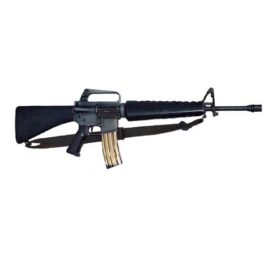
M16 rifle
The M16 rifle (officially designated Rifle, Caliber 5.56 mm, M16) is a family of military rifles adapted from the ArmaLite AR-15 rifle for the United States military. The original M16 rifle was a 5.56×45mm automatic rifle with a 20-round magazine.
In 1964, the M16 entered US military service and the following year was deployed for jungle warfare operations during the Vietnam War. In 1969, the M16A1 replaced the M14 rifle to become the US military’s standard service rifle. The M16A1 incorporated numerous modifications including a bolt-assist, chrome-plated bore, protective reinforcement around the magazine release, and revised flash hider.
In 1983, the US Marine Corps adopted the M16A2 rifle and the US Army adopted it in 1986. The M16A2 fires the improved 5.56×45mm (M855/SS109) cartridge and has a newer adjustable rear sight, case deflector, heavy barrel, improved handguard, pistol grip and buttstock, as well as a semi-auto and three-round burst fire selector. Adopted in July 1997, the M16A4 is the fourth generation of the M16 series. It is equipped with a removable carrying handle and Picatinny rail for mounting optics and other ancillary devices.
The M16 has also been widely adopted by other armed forces around the world. Total worldwide production of M16s is approximately 8 million, making it the most-produced firearm of its 5.56 mm caliber. The US military has largely replaced the M16 in frontline combat units with a shorter and lighter version, the M4 carbine.
In April 2022, the U.S. Army selected the SIG MCX SPEAR as the winner of the Next Generation Squad Weapon Program to replace the M16/M4. The rifle is designated XM5
History
In 1928, a U.S. Army ‘Caliber Board’ conducted firing tests at Aberdeen Proving Ground and recommended transitioning to smaller caliber rounds, mentioning in particular .27 in (6.86 mm) caliber. Largely in deference to tradition, this recommendation was ignored and the Army referred to the .30 in (7.62 mm) caliber as “full sized” for the next 35 years. After World War II, the United States military started looking for a single automatic rifle to replace the M1 Garand, M1/M2 Carbines, M1918 Browning Automatic Rifle, M3 “Grease Gun” and Thompson submachine gun. However, early experiments with select-fire versions of the M1 Garand proved disappointing. During the Korean War, the select-fire M2 carbine largely replaced the submachine gun in US service and became the most widely used carbine variant. However, combat experience suggested that the .30 Carbine round was underpowered. American weapons designers concluded that an intermediate round was necessary, and recommended a small-caliber, high-velocity cartridge.
However, senior American commanders, having faced fanatical enemies and experienced major logistical problems during World War II and the Korean War, insisted that a single, powerful .30 caliber cartridge be developed, that could not only be used by the new automatic rifle, but by the new general-purpose machine gun (GPMG) in concurrent development. This culminated in the development of the 7.62×51 mm NATO cartridge. to know more click here




Reviews
There are no reviews yet.